The first 30 hotels join the initial phase of Smart Data Canarias, the tourism intelligence platform for the sector.
March 11, 2026

This pioneering system allows real-time analysis of sustainability and competitiveness indicators in the accommodation sector and facilitates better business decision-making.
The first 30 hotel establishments in the Canary Islands are part of the rollout of the **Smart Data Canarias project**, presented last July in Fuerteventura. This innovative technological tool enables the real-time analysis of certain sustainability and competitiveness indicators in the Canary Islands’ accommodation sector and aims to position the archipelago as a benchmark in the use of data for decision-making.
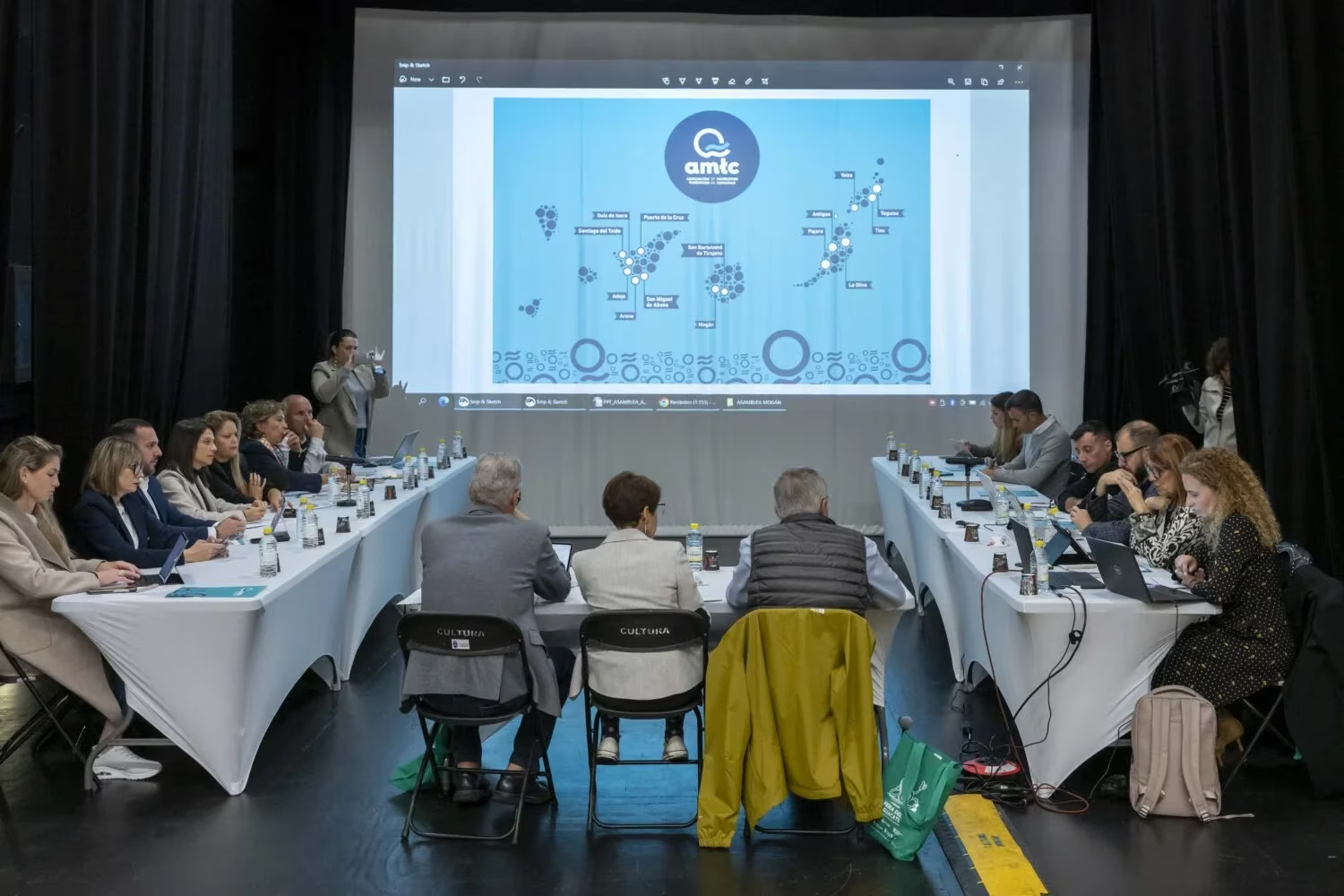
Promoted by the tourism associations **Asofuer, Ashotel, FEHT and FTL**, a preview of the first results from this initiative was presented this morning at Marina Innova Hub in Arrecife. The project is co-funded by the Canary Islands Government’s Department of Tourism and Employment with €600,000 from the Recovery, Transformation and Resilience Plan and through the Next Generation EU funds.
The project develops a tourism intelligence system based on the capture, structuring and analysis of operational, environmental and customer behavior data, with the aim of optimizing processes, reducing impacts and facilitating evidence-based decision-making.
Representatives of the promoting entities that have formed the Smart Data Canarias network—Susana Pérez (president of FTL), Jorge Marichal (president of Ashotel), Juan Cabrera (advisor to Asofuer) and Carmelo León (member of the FEHT board)—took part in the opening of the presentation of results, together with the Canary Islands Government’s Deputy Minister of Tourism, José Manuel Sanabria.
The host of the event, Susana Pérez, commented that “the results of this project demonstrate that the tourism sector in the archipelago is ready to work with a solid and shared data culture. The tourism sector now has a tourism intelligence platform with precise, integrated and necessary information to anticipate demand, optimize resources and improve the visitor experience.” Pérez added that “having this tool allows us to plan better, reduce uncertainty and move toward a more efficient, competitive and sustainable model, marking a before and after in the competitiveness of the Canary Islands’ tourism sector.”
Data as a valuable resource
Jorge Marichal then stated that the project “was born within the sector itself with a clear conviction: data cannot remain a dispersed, dependent or underused resource.” In this sense, he affirmed that “data must become a strategic asset serving our companies, our destinations and the collective interest, assuming leadership in data governance through a model in which information is managed by the sector itself, with guarantees of security, confidentiality and long-term vision.” For this reason, he encouraged the entire hotel sector to join the project, assuring that “the more of us there are, the stronger our information will be.”
“We should congratulate ourselves on the launch of this initiative, which had not previously been considered until we began to see the real importance of data,” added Juan Cabrera, who recalled that the digital transformation being experienced by the tourism sector places great importance on data “not because of the data itself, but because that data is translated into valuable information.”
Likewise, Carmelo León explained that “it is not simply about collecting information, but about structuring it, harmonizing it and turning it into useful knowledge for decision-making,” emphasizing that it is not only a growing asset for companies but also for public administrations, “as it provides them with a solid empirical basis to design more effective policies aligned with the reality of the market.” “This is a cutting-edge project,” he assured.
The project also represents a qualitative leap for the Canary Islands’ tourism sector. This was highlighted by the Canary Islands Government’s Deputy Minister of Tourism, José Manuel Sanabria, who stressed the importance of moving toward management based on data quality. “It is precisely one of the priority lines of work for the Department of Tourism, which will allow us to make better decisions,” he noted. In this regard, he stated that the Department will continue collaborating with the private sector to equip itself with tools and instruments that jointly improve the positioning of the Canary Islands as a tourist destination. He also announced that pilot experiences that have proven successful will be reinforced and expanded.
The event also included the participation of technical leaders of the project, highlighting the firm commitment to innovation and to placing real data in the hands of establishments to facilitate proper decision-making. Among these specialists, José Carlos González, head of the ICT Service at the University of La Laguna (ULL) and member of the ULL BOB Chair (Big Data, Open Data and Blockchain), simulated during his presentation a scenario on how to govern an AI agent so that it can answer strategic questions by combining private data from the hotel itself with aggregated sector data (from the cluster or association), while technically guaranteeing that competitors’ privacy is never violated. He mentioned anonymization at source, machine access control and AI auditing.
Independent data warehous
Juan Pablo González, manager of Ashotel, explained technical aspects of the project, which involved the creation of four cloud-based data warehouses—one for each association—that operate autonomously but are structured in such a way that data can be compared in the future, enabling key information to be shared without compromising the privacy of the establishments. In addition, a dashboard with key sector indicators has been developed, collecting data from hotel management systems (PMS) and IoT devices installed in accommodations.
This dashboard allows the associations and participating establishments to monitor in real time aspects such as occupancy, energy efficiency and sustainable practices. Unlike many external commercial platforms—whose access and use of information are conditioned by market interests—this tool has been designed by and for the Canary Islands tourism sector, under the custody of the business associations. “From now on we will work on incorporating new establishments into the platform, adding new indicators and developing connections with other PMS systems,” he noted.
For their part, the associations Asofuer and FEHT, which share a technology provider, presented the experience of connected hotels in Gran Canaria and Fuerteventura through Adquiver’s CEO, Jorge Núñez, while Evosocial Soft’s CEO, Antonio Álvarez, presented the experience in Lanzarote.
Finally, Candelaria Santos, data analyst at the Ashotel Observatory, presented the main results of the project developed in the province of Santa Cruz de Tenerife, which currently involves 15 associated accommodation establishment
Business experience
To conclude the event, the experience gathered over these months by the participating hotel establishments was discussed in the round table **“Data as a Strategic Asset: Management for Decision-Making,”** moderated by Mario de la Cruz. Participants included Dreamplace Hotels’ Director of Marketing and Sales, Jordi Estalella; Satocan Group’s Chief Data Officer (CDO), Aday Hernández; and the Managing Director of Aylanz Hospitality Group, Sonia Prieto.
If you want, I can also **polish it into a more natural press-release style English version** (more typical for international media) rather than a direct translation.